



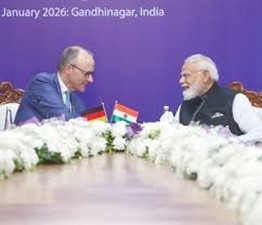
The visit of the Chancellor of the Federal Republic of Germany H.E. Mr. Friedrich Merz to India on 12-13 January 2026, at the invitation of Prime Minister Shri Narendra Modi, coincides with the commemoration of 75 years of diplomatic ties between the two countries. This is Chancellor Merz’s first official bilateral visit to India as well as his first engagement with the Indo-Pacific, underlining the growing significance of the India-Germany partnership and the steady deepening of cooperation across political, economic, technological and strategic domains. Sneha Sinha writes.
The visit of the Chancellor of the Federal Republic of Germany H.E. Mr. Friedrich Merz to India on 12-13 January 2026, at the invitation of Prime Minister Shri Narendra Modi, coincides with the commemoration of 75 years of diplomatic ties between the two countries. This is Chancellor Merz’s first official bilateral visit to India as well as his first engagement with the Indo-Pacific, underlining the growing significance of the India-Germany partnership and the steady deepening of cooperation across political, economic, technological and strategic domains.
The visit builds on recent high-level exchanges, including Prime Minister Modi’s meeting with the Chancellor Merz on the sidelines of the G7 Summit in June 2025 and the official visit of German Foreign Minister H.E. Mr Johann Wadephul to India in September 2025. It also takes place just weeks ahead of the much-anticipated EU-India Summit, where leaders are expected to intensify negotiations for an India-EU Free Trade Agreement and advance a broader strategic agenda.
A notable feature of the visit was the presence of a high-level German business delegation highlighting the business and investment dimension of the partnership. Germany is one of India’s largest trading partners in Europe and a major source of foreign direct investment, playing a central role in India’s economic engagement within the continent and contributes to strong bilateral commercial ties.
Following engagements in Ahmedabad, the Chancellor Merz travelled to Bengaluru, where he visited Bosch Adugodi campus and the Centre for Nano Science and Engineering (CeNSE) at the Indian Institute of Science. These visits showcased the depth of Indo-German partnership in advanced manufacturing, frontier research, industrial R&D, highlighting Bengaluru’s role as a critical place in the global innovation ecosystem. Together, the visit reinforced that the partnership between the two countries are increasingly driven by technology, innovation and strategic alignment.
The discussions during the visit covered the full spectrum of bilateral relations, while also addressing regional and global developments. Recognising the growing trend of control and weaponisation of technologies in an increasingly fragmented global order, both sides emphasised the need to deepen cooperation in science and technology, higher education, space and defence. Additionally, understandings were adopted in areas such as semiconductors, critical minerals, telecommunications, artificial intelligence and digital technologies which lie at the intersection of economic competitiveness and strategic autonomy.
The launch of a new joint R&D programme bioeconomy further highlighted emphasis on innovation-led and sustainability-oriented growth. Equally significant was the reaffirmation of the flagship, Green and Sustainable Development Partnership (GSDP), Semiconductor Ecosystem partnership, Renewable Energy and Battery technologies, alongside progress on green hydrogen, together with a new offtake agreement on green ammonia.
India and Germany have over five decades of cooperation in research and innovation dating back to the Inter-Governmental Agreement on ‘Cooperation in Scientific Research and Technological Development’ signed in May 1974. This long-standing cooperation is marked by several institutional linkages, policy frameworks and people-to-people ties.
Beyond science and technology, Indo-German strategic cooperation spans green and sustainable development, energy transition and global governance. Programmes such as GSDP, the Green Hydrogen Roadmap, and the Indo-Germany Energy Forum facilitate collaboration on renewable energy, climate change mitigation, and just energy transition. There is also potential for deeper engagement through the Global Biofuel Alliance, aligning sustainability goals with energy security. At the multilateral level, both countries actively engage in global initiatives like International Solar Alliance and the Coalition for Disaster Resilient Infrastructure, reinforcing their shared commitment to climate action and disaster-resilience.
Emerging technologies form another critical pillar of cooperation. While collaboration in AI, digitalisation in agriculture, urban mobility and renewable energy is already underway, strategic domains such as semiconductors, quantum technologies and space are being prioritised for future expansion together with traditional medicine. Science diplomacy can play an enabling role through mega-science projects, capacity-building programmes and multilateral engagements to address global challenges and advance the SDGs. Both countries also seek to harness AI for sustainable development, adopting an innovation-led, inclusive and human-centric approach to AI governance. With Germany’s participation in the Global Partnership on Artificial Intelligence and India hosting the AI Impact Summit in February, there is scope for joint efforts in shaping global AI norms, standards and applications. Chancellor Merz’s visit reflects a shared vision of technology, mutual trust and strategic convergence in a fragmented world order.