



The India-Korea bilateral partnership aims for a shift from economic ties to a comprehensive strategic partnership spanning Indo-Pacific security, emerging technologies, defence, and climate cooperation, as envisioned in The India–Republic of Korea (ROK) Joint Strategic Vision (2026–2030). Its success depends on addressing trade imbalances, deepening defence and tech collaboration, and aligning geopolitical priorities to fully realise the partnership’s potential. Sanjeev K. Varshney writes.
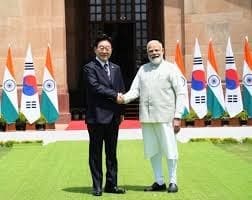
The recent visit of the Republic of Korea (ROK) President H.E. Lee Jai Myung to India and his meetings with Indian Prime Minister Shri Narendra Modi and the President Madam Droupadi Murmu, resulted in deepening of the ‘Special Strategic Partnership,’ with key discussions on semiconductors, defense, artificial intelligence (AI), and space exploration to combine India’s engineering talent with South Korea’s manufacturing prowess.
Two countries also agreed to work on climate related actions, including Arctic research and the blue economy. Korea consented to join the India driven International Solar Alliance to work for green and sustainable energy. India-ROK Space Day was held in Bangalore during the visit. Mapping and exploration of critical minerals using AI, with a focus on building resilient supply chains was also agreed.
Both countries are in active science & technology cooperation. Besides the India Korea Joint Science & Technology Committee, co-chaired by two countries, which nurture and guide joint R&D activities between research of two societies, Korea has also launched several institutional mechanisms, like India Korea Centre for Research & Innovation (IKCRI), which is based in New Delhi and it focuses on technology transfer, innovation, and joint research projects. There is an India Korea Science & Technology Centre (IKSTC) in Bangalore which serves as a global knowledge platform for collaborative research in materials science and renewable energy. Now, Korea India Defense Accelerator (KIND-X) has been launched to connect defense startups, universities, and investors to develop futuristic military technologies.
The India–ROK Joint Strategic Vision (2026–2030) marks a shift from economic ties to a comprehensive strategic partnership spanning Indo-Pacific security, emerging technologies, defense, and climate cooperation. Its success depends on addressing trade imbalances, deepening defense and tech collaboration, and aligning geopolitical priorities to fully realize the partnership’s potential.
The present bilateral cooperation focuses on green mobility, renewable energy, clean water, biomedical devices, and ICT convergence, indicating clear focus on sustainability and greener solutions and enhanced applications of emerging digital technologies. Cooperation would be effected through bilateral scientific projects as well as scholarships to young Indian and Korean researchers, respectively by the Global Korea Scholarships (GKS) and the Indian Council of Cultural Research (ICCR).
In the Digital Integration and Next-Gen Tech sector, it is proposed to establish an India-Korea Digital Bridge, a new initiative targeting critical and emerging technologies (CET). It establishes joint task forces focused on data governance, and semiconductor design and fabrication guided by the principles of “AI for All” and “MANAV”. A Cross-Border Financial Linkage has also been launched and a landmark Memorandum of Understanding (MoU) was signed integrating India’s National Payment Corporation of India Limited (NPCIL) with Korea’s KFTC (Korea Financial Telecommunications and Clearings Corporation). This allows for seamless, real-time cross-border payments, bypassing traditional Western financial clearing houses.
In the Space sector, both countries have agreed to enhance the cooperation by establishing a Joint Working Group between Indian Space Research Organisation (ISRO) and Korea Aerospace Administration (KASA). This Working Group will promote collaboration in various space domains and it began with marking the India–ROK Space Day held in Bengaluru on 20th April 2026.
In Climate Change and Energy Security sector, ROK welcomed India’s participation in the Pax Silica initiative, while India appreciated ROK’s leadership in Forum on Resource Geostrategic Engagement (FORGE). It may be noted that the FORGE is a United States-led multinational initiative launched in February 2026 to secure and diversify global supply chains for critical minerals. India is a supporter and participant of FORGE. Both countries agreed to enhance cooperation on securing critical materials like naphtha during supply disruptions and expand bilateral trade in such resources.
The partnership aims for a shift from economic ties to a comprehensive strategic partnership spanning Indo-Pacific security, emerging technologies, defence, and climate cooperation, as envisioned in The India–Republic of Korea (ROK) Joint Strategic Vision (2026–2030). Its success depends on addressing trade imbalances, deepening defence and tech collaboration, and aligning geopolitical priorities to fully realise the partnership’s potential.